📖 The Social Media Trap
📖 The Social Media Trap
🗝️ Introduction
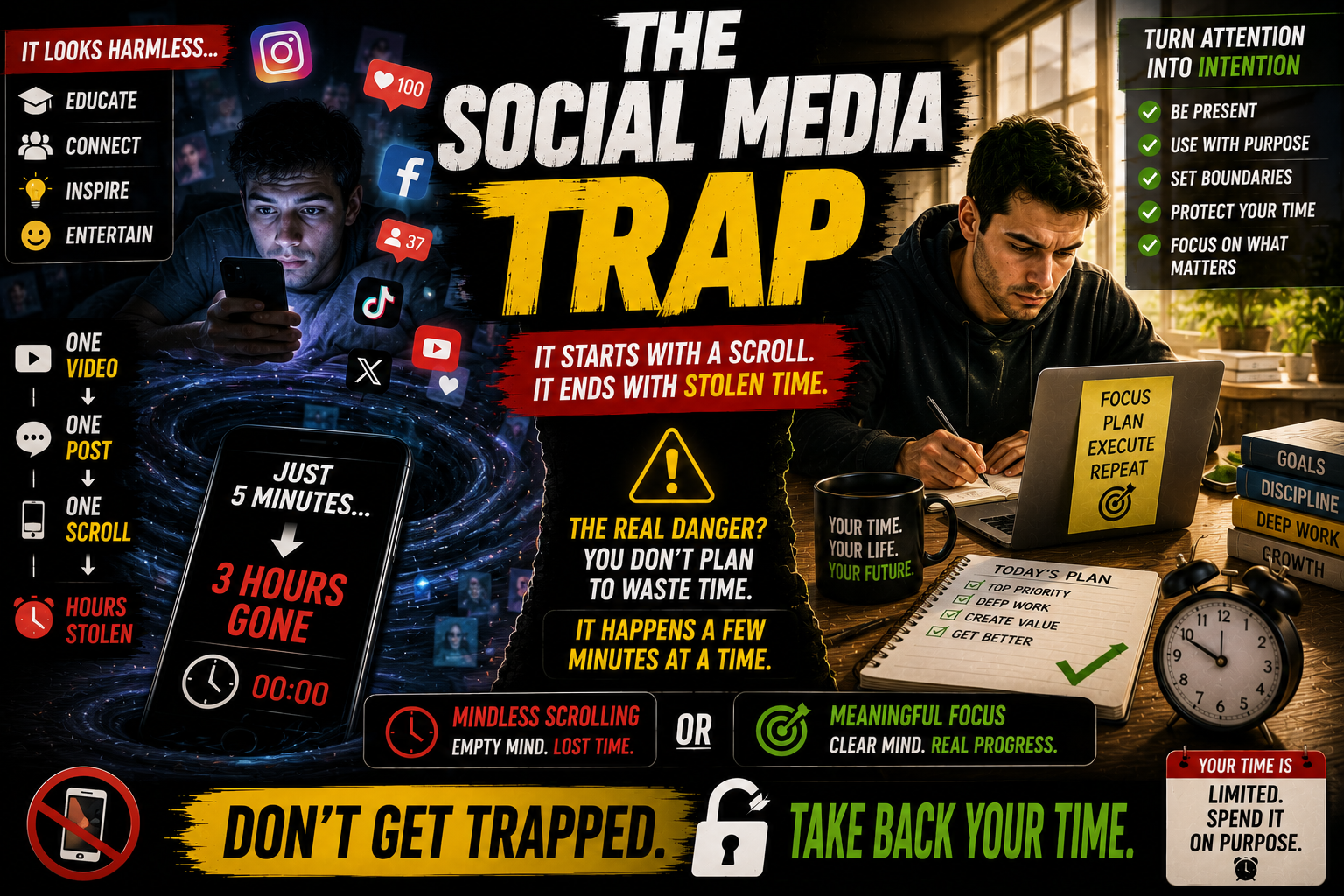
🔹 Social media is not inherently bad
🔹 It can educate, connect, inspire, and entertain
🔹 The problem begins when it quietly takes control of attention
🔹 Most people don't plan to spend hours scrolling
🔹 They lose time a few minutes at a time
🔹 This is the Social Media Trap
🧩 Key Teaching Points
🔹 Social media competes for attention
🔹 Attention is one of your most valuable resources
🔹 Small interruptions create large productivity costs
🔹 Social media often fragments focus
🔹 The real cost is not only time
🔹 The real cost is lost clarity and lost momentum
💥 Why This Happens
🔹 Social media is designed to keep attention
🔹 New content appears endlessly
🔹 Notifications create curiosity
🔹 The brain enjoys novelty
🔹 Scrolling requires little effort
🔹 Stopping requires more effort than continuing
🧨 Embedded Belief
🔹 "I'll check for just a minute."
🔹 "I'm only taking a short break."
🔹 "I won't be distracted."
🔹 "This isn't affecting my productivity."
💡 Real-Life Example
🔹 Someone starts an important task
🔹 A notification appears
🔹 They check social media for 5 minutes
🔹 Five minutes becomes 20
🔹 Returning to the task feels harder
🔹 Focus has been broken
🔹 The time lost was bigger than it appeared
❓ Why This Belief Exists
🔹 Social media feels harmless
🔹 Small sessions seem insignificant
🔹 The costs are difficult to notice immediately
🔹 We see the minutes spent
🔹 We rarely see the focus that was lost
🔗 Interconnections
🔹 Strengthens The Urgent Trap
🔹 Increases Comparing Schedules
🔹 Feeds The Information Consumption Trap
🔹 Creates attention fragmentation
🔹 Weakens Protection Systems
🔁 Replacement Rule
🔹 Replace unconscious scrolling with intentional use
🔹 Replace constant checking with scheduled checking
🔹 Replace notifications with focus protection
🔹 Use social media deliberately, not automatically
📋 Core Message
🔹 Social media is not dangerous because it takes hours
🔹 It is dangerous because it repeatedly steals attention
💡 Simple Examples
🔹 Opening Instagram while studying
🔹 Checking LinkedIn every few minutes during work
🔹 Watching one YouTube video that becomes ten
🔹 Opening TikTok during a short break and losing track of time
🔹 Reading comments instead of completing a task
📋 When to Use
🔹 When focus keeps breaking
🔹 When work sessions feel shorter than planned
🔹 When you constantly reach for your phone
🔹 When social media usage feels automatic
🧠 Simple Formula
🔹 Social Media + No Boundaries = Attention Leakage
🔹 Social Media + Clear Boundaries = Controlled Use
⚠️ Important
🔹 Social media is a tool
🔹 The goal is not to eliminate it completely
🔹 The goal is to control when and how it is used
🔹 Deliberate use is very different from automatic use
❌ What This Lesson Is NOT Saying
🔹 It is not saying delete all social media
🔹 It is not saying entertainment is bad
🔹 It is not saying never take breaks
🔹 It is saying attention should be protected
⚠️ Common Misuse
🔹 Becoming overly restrictive
🔹 Feeling guilty for every minute online
🔹 Treating social media as the enemy
🔹 Ignoring its legitimate benefits
🔄 Recovery Rule
🔹 When you notice yourself scrolling automatically
🔹 Stop immediately
🔹 Close the app
🔹 Return to the next planned action
🔹 Do not wait for the "perfect stopping point"
🔁 Internal Dialogue Shift
Before
🔹 "I'll check quickly."
🔹 "Just a few minutes."
🔹 "This won't affect anything."
After
🔹 "Attention has value."
🔹 "I'll check later."
🔹 "My focus deserves protection."
🎯 Outcome Check
🔹 Can you use social media intentionally?
🔹 Can you delay checking notifications?
🔹 Can you protect focus during important work?
🔹 Can you notice when scrolling becomes automatic?
If yes, the lesson is working.
🧪 Micro-action
🔹 Choose one social media platform
🔹 Turn off non-essential notifications
🔹 Create one scheduled time to check it
🔹 Avoid opening it outside that time for one day
🧪 Solved Example (Step-by-Step)
🔹 Ahmed notices he checks Instagram during every work session
🔹 Each check lasts only a few minutes
🔹 But focus keeps breaking
🔹 He disables notifications
🔹 He decides to check Instagram only at lunch
🔹 Work sessions become longer and calmer
🔹 Productivity improves without deleting the app
📋 What This Reveals
🔹 Most social media time loss is unplanned
🔹 Attention is easier to lose than to recover
🔹 Small interruptions create larger consequences
🔹 Protecting focus often matters more than saving minutes
🎯 One-Sentence Reflection
🔹 Social media rarely steals your day at once—it steals it a few distracted minutes at a time.
🏁 Conclusion
🔹 Social media is designed to attract attention
🔹 That is its job
🔹 Your job is to decide when that attention is available
🔹 Every time you protect your focus, you protect your progress
🔹 Use social media as a tool
🔹 Don't let it become the system that controls your day. 🚀
5 comments